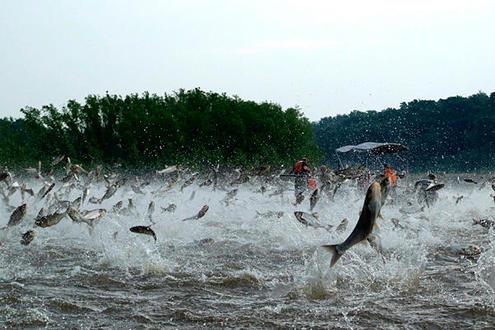

Seize the Carp! by Drew YoungeDyke Most anglers now know not to wear felt-soled waders. We've hung them up in favor of rubber soles because we don't want to transfer organisms from one watershed to another where they don't belong. I really loved my felt-soled Cabela' s waders; they were passed down from my grandpa and worked great. Occasionally they sprung a leak and I sealed the offending seam, but then I learned about how aquatic nuisance species can hitch a ride in the felt and end up in the wrong stream. So, I bought rubber-soled waders which were a little stiff and didn't grip as well, so I have to wade a little more carefully. It's worth it, though, to know that I'm not harming the waters I love. I know I'm burying the lead here, but I mentioned my old waders because there is a much more serious watershed transfer threatening the entire Great Lakes, and we, as a nation, haven't yet traded in our old waders. Asian carp have been moving up the Mississippi River since they escaped from southern fish farms in the early 90's, and now they're poised to invade Lake Michigan through the Chicago Area Waterway System, a canal system that's been used for well over a hundred years. Shippers are used to it. Chicago is used to it. The Army Corps of Engineers is used to it. But, like hanging up an old pair of felt-soled waders, we have to close the artificial connection between the Mississippi River and Great Lakes watersheds before we ruin the waters we love. The Army Corps of Engineers has erected an electric barrier in the Chicago Sanitary and Ship Canal, but Asian carp eDNA has been found on the lake-side of the barrier since 2009. A federal lawsuit to force closure of the locks separating the canals from the lake is pending. The Corps commissioned a study on closing the inter-basin connection, due in 2015, but earlier today the Great Lakes Commission and the Great Lakes and St. Lawrence Cities Initiative released an independent study on the feasibility of separating the basins. You can view the report here, so I won't go too far into the details. The gist is that the cost of the proposed plans could range from $3.9 billion to $9.5 billion, depending on the plan chosen. The projects would likely have to be federally-funded, and include flood-control tunnels and alternative routes for shipping and boating. While this sounds like a lot of money, and it is, it is a reasonable cost to save a Great Lakes fishery which generates $7 billion in annual economic activity. Asian carp are voracious eaters and can completely conquer waters they inhabit by starving out native species, like a wedding crasher who eats all the cake. It's not only the lakes which are at risk, but all the connecting waters, too. If you're like me, you're visualizing how your favorite river connects to a Great Lake right now. As far as we know, Asian carp have not yet established a viable population in Lake Michigan, but it's only a matter of time before they do if we do nothing about it. Spending $4 to 9 billion to separate two watersheds sounds daunting; but when you consider the $7 billion fishery it would save, it's a no-brainer. It would be like spending $40,000 to $90,000 to obtain a college degree in order to secure a job which pays $70,000 a year. I think most rational people would make that investment, and so should we as a nation. In fact, that would be a better financial return than I've received for my law degree so far. I miss my old waders, though they hang on my garage wall as a memento. I have to admit that it took a little while to get used to my rubber-soled waders, but now they're broken in and I don't have any problem wading Michigan rivers in them. There will also be an adjustment when we separate the watershed, and we'll have to make sacrifices to do it; some more than others, admittedly. It will be a sound investment, though, in order to save the greatest freshwater resource in the world. |
2 Comments
|


RSS Feed