 By Drew YoungeDyke (Originally published in the October 2020 issue of Woods-N-Water News)
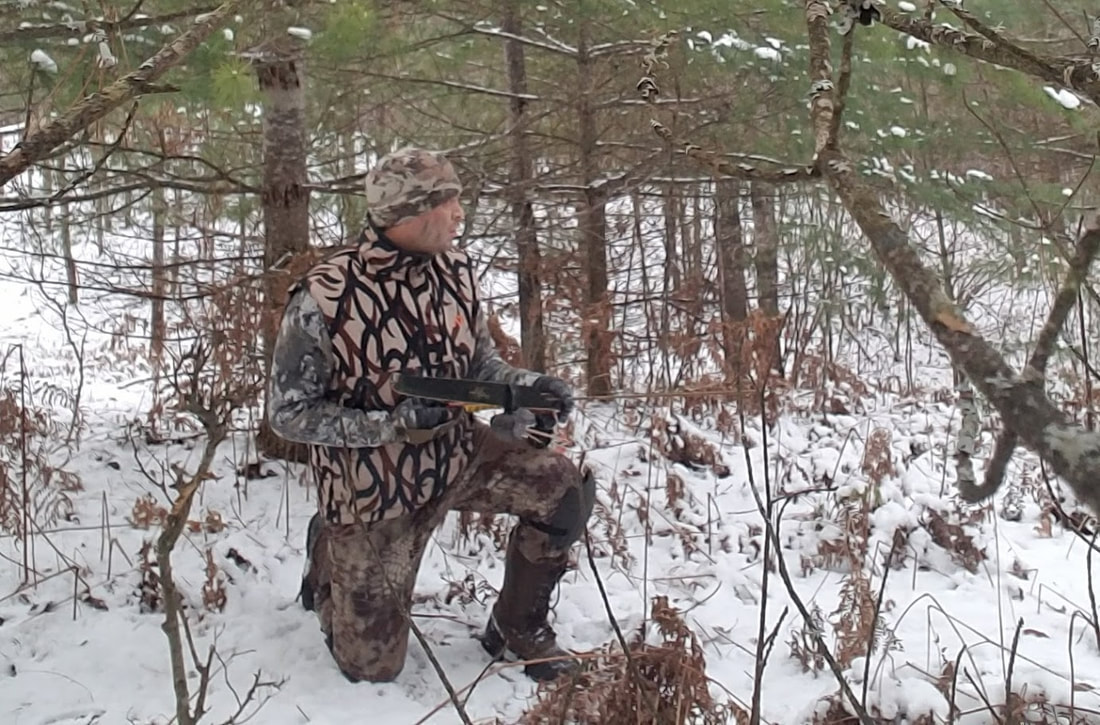
The topography looks just right. A slight knoll just inside the treeline at the edge of marsh, creating a natural funnel between the two. I kneel at the base of a tree on the opposite side of the knoll, about 35 yards away, so that just my head can see above it and I can rest against the tree. A short while later, a four-point walks through the funnel followed by a six-point. I carefully raise my bow, set the 35-yard pin on the six-point’s vitals, take a breath, and release an arrow. It sails underneath: too short. They both bolted. This is still hunting, I think. After that miss, while hunting public land on Beaver Island out of a backpack camp, I wondered if I’d ever find success still hunting deer. Was it madness to commit myself to a method with a lower chance of success? Why couldn’t I just do the tree stand/trailcam/food plot thing like seemingly everybody else? The answer was more complex than the success rate of the method, though. Still hunting is a simple concept that is hard to accomplish. It is hunting by moving slowly and silently through a landscape suspected to hold deer. In practice that means taking careful steps and stopping often – being still – while being observant for the slightest sign of deer, while paying close attention to wind, sound, your scent, and your surroundings. It can be done with any tool legal for deer hunting, increasing in difficulty in inverse relationship to the range of the firearm or bow. And it can take years to find success with each progression of difficulty. Or, luck can strike immediately. In truth, every encounter with deer while still-hunting feels a little lucky but it takes an almost perfect execution of the craft to kill a deer with the method. Rather than a deterrent, this is what hooked me on still hunting as my primary method for deer hunting. While some deer hunters find satisfaction in progressing maybe from smaller bucks to larger bucks, or from many deer to mature deer, I find it in seeking – and most often failing – the perfection of the woodcraft needed to successfully harvest any deer by still hunting. It’s also about the adventure of what might be in the field of view opened up by the next careful step. It could be a deer itself or funnel you’ve never seen with just the right cover at just the right distance that you have to sit for a few hours. It’s the freedom of being able to move to the next field of view at any time coupled with the discipline to stay and acquiring the experience of knowing when to do which. It’s the craft of moving silently – when I move at all – through a wooded landscape with the leaves changing in October or on a soft snow in November. It’s using the same method my dad taught me and my grandpa taught him. Most of all, though, it’s channeling the hunting instinct and feeling as purely human as I’ve experienced. On the Michigan archery opener after that miss on Beaver Island, I hunted along a deer trail in the Pigeon River Country. I often use deer trails as my travel routes when still-hunting because there is less vegetation to brush against and make noise. However, I do this only in wild public land, not where treelines on ag fields create funnels, for instance, where I might spook out mature bucks. In the country I hunt, deer trails are abundant and go in every direction. I determine the direction I want to take by the wind, the cover, and the contours of the land, and use the criss-crossing deer trails to piece together my route through the section I’m hunting. On that day, along that trail, I saw the movement of two does on a trail perpendicular to the one I was on. Ground vegetation was high so I dropped to a knee with my compound. I waited silently for the front doe to present a shot, drew when its head was down and facing away, and released the arrow. It ran twenty yards and dropped, its heart stopping while mine raced. I waited several minutes and then walked to it, discovering that it was a button buck, not a doe. Not my intention, but it would make good eating. I tagged it and carried it back to my backpack camp over my shoulder. Still hunting isn’t always moving; it often requires long periods of uncomfortable stillness without the comforts set up in a blind or a tree stand. The next year, I spent four days still hunting out of a backpack camp in the same part of the Pigeon River Country surrounded by bugling elk. By the last day, I had seen and blown stalks or otherwise spooked a dozen deer and missed one, the arrow deflected by vegetation I’d not noticed. Almost defeated, I glassed a valley from a ridge and saw a doe moving slowly though it. I crawled to the edge of the ridge and partway down it to set up behind some old timber slash. If the doe kept going the same direction, it would pass below me within bow range. Instead, it bedded down. I held my position laid back against the hillside behind the short slash pile, carefully raising my binoculars every now and then to look where it bedded. Well-hidden, I began do doubt myself, wondering if I missed it walking away at some point. Finally, it got up and walked right where I originally hoped it might. I drew my compound under the cover of the slash pile, but then the doe started walking up the trail toward me. I held my draw for about 45 seconds before I thought I might be able to get away with raising the bow without spooking the doe. I raised the bow, the doe looked toward me, and I released the arrow into front-quartering vitals at a distance of 35 yards. It dropped on the spot and I gutted it while two bull elk sparred less than a football field away. That was the last deer I’ve taken still-hunting with a bow; the next year I switched to a recurve and the 35-yard shots I might have taken with a compound have just been the starting point for a stalk with the recurve. Two years ago, I hunted along a ridge near an old logging two-track heading downhill with forest on my left and open upland on my right. I saw three does in the valley below and crawled downhill along the tracks to behind a small fallen log, each movement carefully planned while watching the does to avoid alerting them. I was still about 50 yards away, though, well beyond my 20-yard recurve range. Finally, I thought the coast was clear as trees blocked their view of me to leave the blowdown. I closed the distance maybe ten or fifteen yards when one of the does detected me, blew, and they all ran away while my heart pounded. In all my hunting experience, I don’t think I’ve ever been more infused with our natural human hunting instinct than on that stalk. As the September wind hints at the October to come, it stirs that instinct within me. And come October, there will come a moment when I engage it again, walking along a deer path, spotting some portion of a buck or doe, nocking an arrow to my recurve, and putting on a stalk. I don’t know if I’ll be successful or have another empty freezer, but I know I’ll be chasing perfection, on public land ground, in an intimate dance with a deer, without a tree stand in sight. I’ll be a still hunter once again. And in that perfect moment, that is all I will be. By Drew YoungeDyke This Michigan Outside column was originally published in the December 2019 issue of Woods'N'Water News. A frigid dawn crusted the snow with a crunchy top layer that made still hunting all but impossible on last year’s opening day. As it warmed up, though, it became soft and quiet and fresh snow fell overnight. Early the next morning before dawn I crawled out of the sleeping bag on my cot in our deer camp’s outfitter tent in the Pigeon River Country State Forest and dressed for the day with the excitement of a child on Christmas morning: we had tracking snow.
Fresh snowfall during deer season awakens the inner Natty Bumpo of Northwoods hunters. At least it does for me as a dedicated still hunter unless conditions are absolutely prohibitive. It’s a method passed down to me from my dad and my grandpa, as was the Winchester Model 70 I loaded with Federal premium copper ammunition at legal shooting light. I hiked uphill into the woods behind camp and cut for sign, hoping to find a buck track that would fit one of my .30-’06 rounds but willing to follow a smaller buck or a doe that may attract one. When still hunting, I usually follow deer trails. Deer take the path of least resistance, and often it is the path that will allow me to travel more quietly through thick cover. Unlike farmland, on northern Michigan public land forests deer trails go all over, not following any one definitive runway. This allows a still hunter to follow one doe trail to the next to piece together a route consistent with the terrain and wind, always alert for deer sign and presence, but it also makes it difficult to tell which trails are being predominately used. I’ve become adept at following fresh deer tracks without snow, but when fresh snow blankets the ground the picture becomes infinitely clearer. On these days, with soft footfalls and hopefully falling snow to mask my scent and movement somewhat, I’ll take a promising track and just follow it wherever it goes. On the second day of firearm season last year I found a very fresh medium size track that could be either a large doe or small buck. I decided to follow it, even though I didn’t have an antlerless tag, in case it was a small buck or a doe that would cross paths with a larger buck. The wind cut generally crossways from the direction of the tracks and I followed them all morning through upland cover, wetlands, hardwood hills, young red pine valleys, around in a circle where it checked it’s back trail, and up along a ridge where I shot an eight point a few years ago. It was as good of a workout as you’ll find in the deer woods other than the drag out. Still hunting is the most all-consuming method of deer hunting for me. Every sense is engaged. Every twist and turn of the track, every new viewscape, tingles the senses with anticipation. Your eyes search below every red pine branch; maybe the deer bedded down. Looking for a horizontal shape in every stand of hardwoods. A flicker of an ear through the falling snow. Stopping and kneeling frequently to scan every quadrant with binoculars, wondering what could be on the other side: a six point you would gladly take for the freezer? A doe that will intersect the path of an older eight point farther on? Along the way, you learn more about the deer. Tracking snow has always told stories of the deer woods for observant hunters. During one of the first deer seasons I hunted at our former deer camp on Beaver Island, it told a story that, as much as any other, helped me understand the workings of nature. I followed the fresh track of a small deer along a trail just after dawn. From one side, a coyote’s tracks dropped in behind it. Another’s joined from the other side. The deer’s walking gait disappeared and reappearing in a bounding leap and the coyotes’ spaced out, but it was too late. A spatter of blood on the trail and then all three veered sharply off into the thick swamp. It can tell our tales, too. A few years ago, before we moved our deer camp to the Pigeon River Country, I was camped out alone away from the road behind a couple-year-old clear cut. My dad planned to meet me at the camp for lunch one day and hunt with me in the afternoon, so at dawn I followed the fresh track of a buck away from camp into the woods. I veered away from it to avoid putting the wind at my back at times and rejoined it, guessing from the cover and direction where it might be headed. Toward mid-morning, I saw the blaze orange of another hunter in the woods and was going to veer away in another direction, but the other hunter saw me as well and waved. The hunter’s outline looked familiar and I recognized my dad, but how did he find me a half mile from camp after I’d swung wide away? He couldn’t have followed my tracks and caught up to me, even as slow as I was going. He told me he saw the direction I was headed, saw the track I was following, and saw where I veered away from it. And since he taught me how to track and still hunt, how to hunt the way I did, he thought about what he would do, given the sign and terrain, guessed where I would end up if I did the same thing, and meet me there. And that’s exactly what he did. I wondered what tales I would trail on this hunt. What would the tracks tell me? I found fairly fresh pellets, which confirm that I’m not too far behind the deer. I see where it stopped to pee, though, and the yellow snow is behind it, indicating it’s likely a doe. I pass no fresh rubs. Finally, I see what I’ve been following. A horizontal brown body amidst vertical hardwoods. I see the doe just before she sees me and bounds away; I took that one step too many and too fast that every still hunter realizes a moment too late. Without an antlerless tag, it would be a pass anyway. I tracked another deer the next day and watched the doe from 40 yards away wishing I had an antlerless tag. They were the only deer I saw last season. Tracking snow has yet to connect me with a deer for the freezer. I’ve killed a few deer still hunting with a bow and a rifle, though, following deer trails without snow. My best deer, the eight point I shot from the ridge a few years ago, was killed after still hunting and following a fresh deer trail in the afternoon until it crossed a saddle into a valley I’d scouted in the offseason. I sat against the base of a tree on the ridge overlooking the valley and passed up a fork and two does before shooting the buck cruising for does. Just as every bend of the trail excites this hunter with anticipation while tracking deer in the snow, so does the dawn of each new season. My rifle is sighted in with premium copper bullets, I’ve scouted our public land hunting grounds, and my freezer is stocked with pasties ready to fill the cooler at deer camp. And this year, I drew a public land antlerless tag for Otsego County. Now if only I can get some tracking snow to go with it… (UPDATE: I still-hunted upon a pair of does, drew my rifle on one offhand, and as I hesitated - and probably moved the rifle too much - trying to ensure it wasn't a button buck, it blew and ran before I took the shot.) |
AUTHOR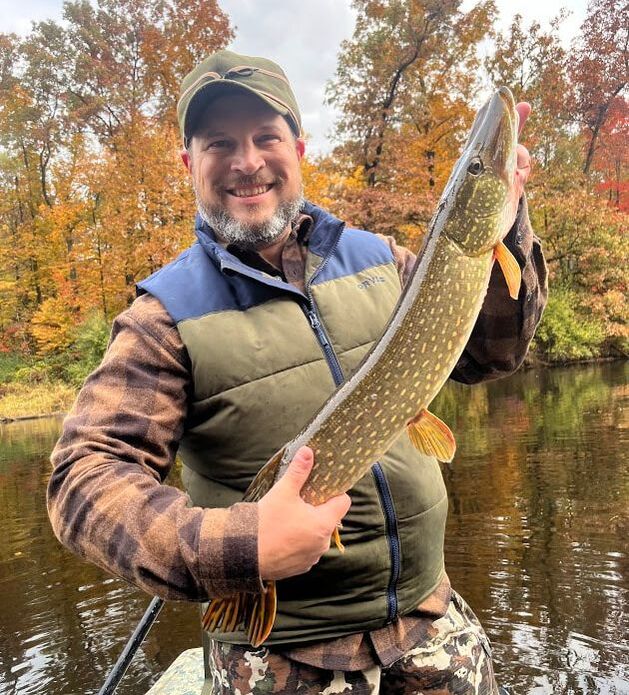
Drew YoungeDyke is an award-winning freelance outdoor writer and a Director of Conservation Partnerships for the National Wildlife Federation, a board member of the Outdoor Writers Association of America, and a member of the Association of Great Lakes Outdoor Writers and the Michigan Outdoor Writers Association.
All posts at Michigan Outside are independent and do not necessarily reflect the views of NWF, Surfrider, OWAA, AGLOW, MOWA, the or any other entity. ARCHIVES
June 2022
SUBJECTS
All
|

 RSS Feed
